
Pen-y-Crug
As you sit on the coach house patio you can see the sun rising over Pen-y-Crug. A beautiful sight over what appears to be just a small hillside in the distance. In fact in ancient times it was an important hill fort the remains of which are visible today. The Iron Age hillfort dates from 800BC to 75AD. The Crug (pronounced cree-g) is the Welsh name for the ‘top of the mound’. You can still see the main entrance to the fort coming in from Brecon town.
It is clear to see why Iron Age people chose to build a defendable settlement here. The hill has extensive views of the central Brecon Beacons. It also has views to a number of neighbouring hillforts including Coed Fenni Fach on the adjacent (now wooded) hill and to Twyn y Gaer on Mynydd Illtud on the other side of the valley.
Construction
The ramparts follow closely the contours of the upper part of the hill. For most of the circuit there are four ramparts and a counterscarp bank, reduced to three on the west where the slope is steeper. The banks were constructed of earth and stone, probably by the method termed ‘downward construction’. Traces of a quarry ditch are visible behind the innermost rampart. The enclosure measures internally 182m north to south, by 134m, an area of 1.92 hectares; externally the entire hillfort enclosures 4.29 hectares. The outer faces of the highest banks attain a height of 5.2m in places.’
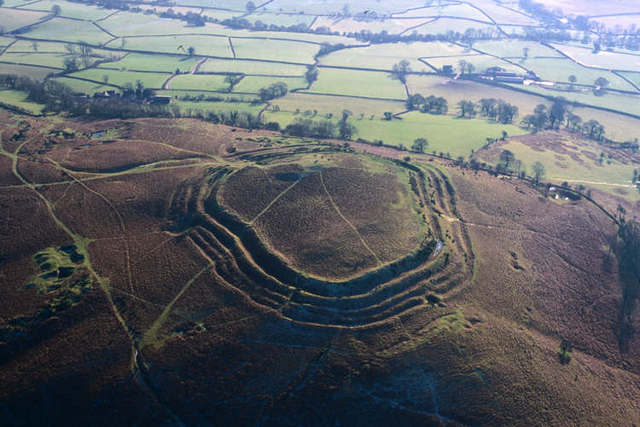
There is some evidence of possible earlier occupation on the site. The ramparts, which are rounded earthwork banks and ditches today, would once have been impressive stone and earth revetments with a wooden defensive palisade built on top. This allowed those who occuping the hillfort to defend themselves. It was a formidable obstacle to anyone attempting to attack the settlement. Entry to the interior of the hillfort was gained through a single well-guarded entrance on the south-east side of the hillfort.
During the Iron Age Pen-y-Crug would have been a very busy place, where people lived, worked, farmed and traded. Little survives today, above ground, of the round houses, stock pens and granaries that once occupied the interior of the hillfort. With a little imagination you can step back in time to see how they lived here.

Dark Skies Brecon Beacons Holiday Cottage
Aberyscir coach Houses – Brecon Beacons Guide